JPL’s GSAT Testbed Gets Smart
Reinforcement Learning for Fault Tolerant Robotics in the JPL GNC Spacecraft Autonomy Testbed
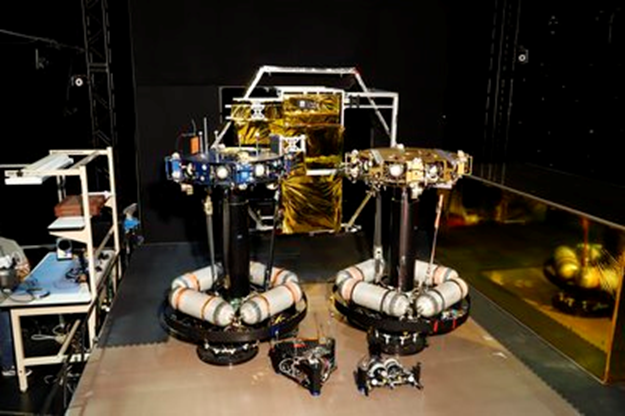
JPL GSAT air bearing robot platforms. Courtesy NASA/JPL-Caltech.
David Sternberg
Jet Propulsion Laboratory, California Institute of Technology
© 2026. California Institute of Technology. Government sponsorship acknowledged.
Introduction to JPL GSAT
The Guidance and Control Spacecraft Autonomy Testbed (GSAT) at NASA's Jet Propulsion Laboratory is a unique facility for developing autonomous guidance, navigation and control (GNC) algorithms, relative sensor technologies, and science and engineering payloads that require GNC functionality to perform correctly. Its hardware, software, and environmental conditions allow high fidelity, system-level ground testing of spacecraft architectures and autonomous operations. A key advantage of the GSAT is that it allows investigations into the true dynamics of a spacecraft under either active or passive control and the interaction with sampling/landing surfaces or docking with other bodies in space.
A Unique Testing Environment
One of the features of the GSAT is a set of testing platforms: air-bearing robots that rely on thin films of air for nearly frictionless motion, mimicking the frictionless environment of space. While the GSAT has two types of these robots, with the larger mounting spherical air bearings atop planar air bearings, smaller robots are solely planar air bearings that enable two-dimensional translational motion and rotation about a vertical axis. These robotic systems are commanded using the F’ architecture with modular software and create an ideal testbed for validating spacecraft control algorithms. Each is equipped with compressed air thrusters arranged in a symmetrical configuration and tracked by a high-precision Vicon motion capture system, allowing the facility to provide researchers with real-time position and attitude data as the robots maneuver on an 8x11m flat floor.
The facility at JPL, which is a division of Caltech, has supported numerous spacecraft technology demonstrations over the years, helping to validate propulsion systems and control algorithms that have made their way onto actual missions. The facility also has supported multiple early-stage research projects, including a reinforcement learning task over the past three years.
SmallSat Steward: Three Years of Innovation
From 2024 through 2026, GSAT became the proving ground for the SmallSat Steward project, a University SmallSat Technology Partnership program led by Prof. Oliver Jia-Richards at the University of Michigan in collaboration with JPL. The project's goal was forward thinking towards increased autonomy in space: develop a spacecraft control system that could autonomously adapt to critical failures like thruster malfunctions that would typically doom a mission.
The approach centered on Dyna, a reinforcement learning framework that combines real-time learning with forward planning. Unlike traditional controllers that follow pre-programmed responses, Dyna learns from experience and simulates potential futures to adapt its strategy on the fly. The GSAT provided a hardware in the loop testing environment with a flight-traceable set of avionics and flight software to assess the Dyna framework.
Year One: Proof of Concept
Initial testing in 2024-2025 demonstrated the initial concept for the Dyna architecture. Using a Raspberry Pi 5 as the onboard processor, the Dyna agent showed it could adapt to model uncertainties and reduce steady-state errors from 22 cm (using traditional LQR control) down to just 6 cm. The agent ran at a realistic 5 Hz control frequency, using the typical time between control cycles to continuously plan and learn.
Year Two: Rigorous Validation
The second year focused on comprehensive hardware testing to bridge the sim to hardware gap. The team conducted repeated trials comparing three approaches: traditional LQR feedback control, standard TD3 reinforcement learning, and the proposed Dyna architecture.
The results showed the efficacy of the Dyna approach. When facing single and double thruster failures, with the most-used thrusters being deliberately disabled at the start of each test without the software being made aware of the configuration change, only Dyna successfully completed the regulation tasks across all trials. The LQR controller, representative of how most spacecraft are controlled today, couldn't adapt. The standard reinforcement learning approach also demonstrated inferior performance compared to Dyna, which repeatedly navigated the air bearing robot to its goal point despite losing critical thrusters. This year’s testing demonstrated robustness of the Dyna approach with very similar trajectories across multiple tests.
Year Three: Refinement and Insights
The final year focused on understanding performance sensitivities to push the technology toward flight readiness. Through systematic testing, the team discovered that Dyna's critic component was the most critical element affecting performance. This insight provides a clear path forward for future implementations. Continued testing in the GSAT provided further validation of the simulated models used for training and performing Monte Carlo assessments of the Dyna framework, which in turn enabled further assessments of the Dyna critic and determining how the critic could be further improved for more precise trajectory generation and control.
Looking to the Future
As the SmallSat Steward project concludes at the end of the 2026 fiscal year, the team is preparing their Dyna architecture for potential flight demonstration. The three years of testing within the GSAT have transformed the Dyna framework concept into a vastly matured technology capability that could meaningfully alter how spacecraft handle unexpected actuator failures during critical operations like cislunar station inspection and other proximity operations maneuvers.
The GSAT continues to prove that the best way to ensure mission success in space is to perform incremental, iterative test campaigns in a combined simulation and hardware testbed facility so that engineers can learn software architecture idiosyncrasies and determine expected in-flight behavior characteristics.
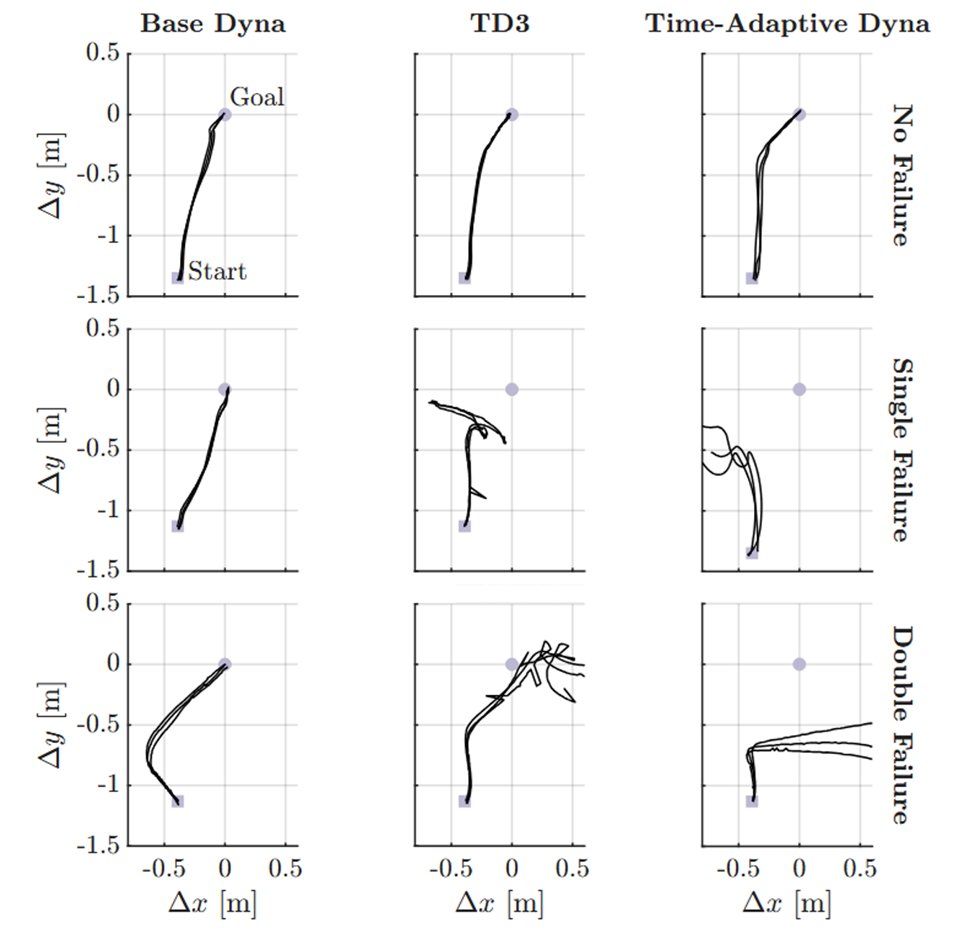
2D profiles of trajectory and control architectures under varying thruster failure scenarios while testing on the GSAT small air bearing robots.
The research was carried out at the Jet Propulsion Laboratory, California Institute of Technology, under a contract with the National Aeronautics and Space Administration (80NM0018D0004). The work was funded by NASA's University SmallSat Technology Partnership (USTP) initiative.
